Online Master of Engineering with a focus area in AI and Machine Learning
At-A-Glance Heading link
Curriculum Heading link
The Online Master of Engineering (MEng) with a focus area in artificial intelligence (AI) and machine learning (ML) program is a professional, non-thesis degree comprised of nine courses in the areas of leadership development and AI/ML.
The core AI/ML classes will help students develop their understanding of the fundamental math of AI and ML, and AI and ML theories, techniques and tools. They will apply this knowledge more deeply in the courses of Image Analysis and Computer Vision, Deep Neural Networks, and Natural Language Processing.
Students have the opportunity to introduce their own project ideas in both the Innovation Tools and Methods Course and the Engineering Management Course. Our Engineering Law class will cover a broad introduction to relevant implications that arise from emerging technologies, such as the ethics around AI and ML.
Students in this program earn a Master of Engineering degree which will be reflected on their transcript and diploma.
Learning Outcomes Heading link
- Solve complex problems with a wide range of AI and Machine Learning tools.
- Apply AI and Machine learning techniques to real-world applications and a broad range of data sets.
- Develop applications that include AI and Machine Learning functionality.
- Learn leadership skills relevant to innovation and project management.
- Gain a fundamental understanding of ethics and fairness in the development and application of artificial intelligence.
slate form Heading link
slate ping Heading link
Courses Heading link
-
9 courses total Students have the option of completing the program at a pace that fits their needs.
-
12 months Full-time students can complete the entire program in as few as 12 months.
Courses Heading link
Learn from our distinguished faculty at the leading edge of research in their respective disciplines and prepare to redefine your role in today’s dynamic artificial intelligence and machine learning environment. For the online Master of Engineering degree, you will complete these 9 courses totaling 36 credit hours. With accelerated 8-week terms, this degree can be completed in as few as 12 months.
All courses are offered in convenient, accelerated 8-week terms throughout the year, giving students maximum flexibility. Full-time students typically take two 8-week courses at a time, and part-time students complete one 8-week course at a time. Full-time students can complete the entire program in as few as 12 months.
Click the arrow below to view MEng courses.
Online Master of Engineering Courses Heading link
Click the arrow below to view MEng courses.
-
MEng Courses
Course Code Course Title Credit Hours Course Description MENG 400 Engineering Law 4 Hours Overview of the legal system. Legal principles affecting the engineering profession. Professional ethics in engineering. Intellectual property law. Basic contract and tort principles. Environmental law. MENG 401 Engineering Management 4 Hours This course will cover the project lifecycle for successful and effective managing of the engineering projects in accordance with the theories, insights, and principles of the Project Management Body of Knowledge. The course will elaborate on understanding the sophisticated dynamics of Engineering Management through expanding on project constraints, such as scope, cost, time, risk, quality, and so forth as well as providing details on the means and methods to enable engineering managers to attain a better and multi-dimensional understanding of the project lifecycle, and the necessary skill sets to efficiently manage the engineering enterprise. MENG 404 Math Fundamentals for AI Engineers and Data Scientists 4 Hours MENG 404 sets the stage for the ML and AI topics that students will see throughout the MENG program. While recalling important mathematical and statistical topics, MENG 404 will also familiarize students with Python which has become an industry standard for ML and AI calculations. Also, while refreshing the students' background material they will be introduced to applications where that material will be covered more thoroughly and further applied in their upcoming MENG courses. MENG 407 Innovation Tools and Methods 4 Hours Working engineers need to know about Innovation Tools & Methods because these are the interdisciplinary business techniques that ensure that the problems we choose to solve and the products we make to solve them actually meet the needs of the human beings who use them (and thus achieve success in the marketplace). Most engineering have heard about the importance of figuring out what people actually need, but this course teaches the concrete techniques are currently accepted best practices for doing so. ECE 415 Image Analysis and Computer Vision I 4 Hours Image formation, geometry and stereo. Two-dimensional image analysis by fourier and other 2-D transforms. Image enhancement, color, image segmentation, compression, feature extraction, object recognition. ECE 491 Intro to Deep Neural Networks 4 Hours Deep Neural Networks (DNN) are the leading pattern recognition methods in AI. They are very successful at correctly classifying a wide range of input data, including images, video, speech, text, and they successfully model consumer preferences. We now use DNNs in our daily life ranging from automated telephone systems to user recommendations on online shopping and entertainment applications (Amazon, Netflix). DNNs can also automatically generate graphics, natural looking images, natural sounding speech and text. CS 411 Artificial Intelligence 4 Hours CS 411 will provide students with experience with a range of AI tools including search, reinforcement learning, probabilistic models, and game theory with the goals of understanding their strengths and limitations and being able to apply then to problems they may face during their career. CS 412 Intro to Machine Learning 4 Hours This course gives an introduction to common machine learning tasks (e.g., classification, density estimation, clustering) and some of the successful machine learning techniques and broader paradigms that have been developed for these tasks. The course is programming-intensive and a large emphasis will be placed on tying existing machine learning techniques to specific real-world applications through hands-on experience. By taking the course, students will be able to explain the mechanism of different common machine learning task settings and be able to apply existing machine learning tools to a broad range of data sets. They will also be able to identify appropriate problem formulations and machine learning techniques for framing and solving predictive data analysis problems, along with evaluating and measuring the performance of different learning techniques on predictive tasks. CS 421 Natural Language Processing 4 Hours In the class, we will study some background theory and focus on engineering techniques and libraries to allow computers interact with humans in a natural language. We will also cover topics such as extracting facts and concepts from text, and other applications of NLP to mainstream applications.
MEng Curriculum Heading link
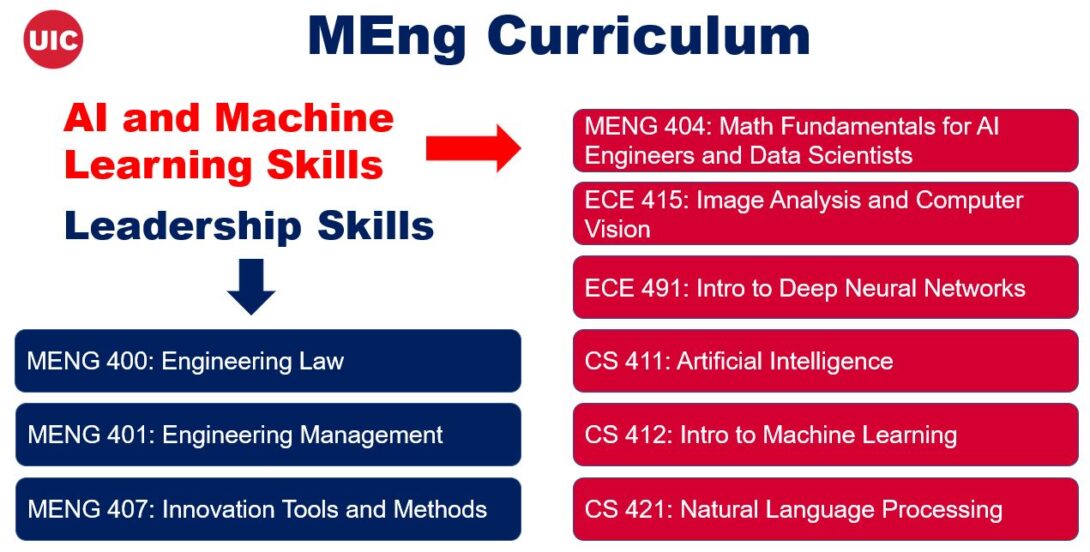
This professionally oriented program teaches students solid foundational knowledge of the interdisciplinary field of AI and ML and the relevant tools to apply these skills to solving complex problems across domains.
Careers Heading link
A Master of Engineering (MEng) degree can open up a wide range of career opportunities in various industries where AI and machine learning are playing an increasingly important role. Our MEng program offers you a unique opportunity to build on your strong engineering foundation and dive headfirst into the cutting-edge world of artificial intelligence.
The job outlook for careers in artificial intelligence is excellent. Over the next few decades, AI is expected to grow explosively as it becomes capable of accomplishing more tasks. With this growth comes the need for information technology experts to determine how and where to implement artificial intelligence at various companies. The United States Bureau of Labor Statistics expects employment of computer and information technology occupations to grow 13% from 2020 to 2030. Moreover, according to a Reuters report based on Indeed.com data, U.S.-based generative AI job postings were up by 20% in May 2023.
Not only are there are range of positions that MEng graduates might be well suited for, but there are also salary ranges for AI careers that depend on the position and the responsibilities.
- According to Indeed, the salary for artificial intelligence careers ranges from approximately $99,568 for a full stack developer to $141,318 for a data scientist.
- The average annual base pay for artificial intelligence salaries in the United States is $120,049, according to Glassdoor.
- According to Talent.com, the average artificial intelligence salary is $143,054 per year. Entry positions start at $115,000, and most experienced employees can make up to $200,000 per year.
Here are some potential roles for MEng graduates:
Machine Learning Engineer: This role involves designing and implementing machine learning algorithms and models to solve specific problems, often in industries like finance, healthcare, and technology. According to Indeed.com, the average base salary is $160k.
Data Scientist: Data scientists analyze large datasets to extract valuable insights and develop predictive models. They are in demand across industries such as e-commerce, finance, healthcare, and more. According to Indeed.com, the average base salary is $125k.
AI Research Scientist: These professionals work in research institutions or tech companies to advance the field of AI through innovation and experimentation. According to Glassdoor.com, the average base salary is $100k – $162k.
AI Product Manager: AI product managers are responsible for guiding the development of AI-powered products and ensuring they meet customer needs and market demands. According to Glassdoor.com, the average base salary is $135k.
Computer Vision Engineer: This role focuses on developing algorithms and systems that can interpret and process visual information, commonly used in autonomous vehicles, healthcare imaging, and surveillance systems. According to Indeed.com, the average base salary is $135k.
Natural Language Processing Engineer: NLP engineers work on applications involving text and language, such as chatbots, sentiment analysis, and language translation. According to Payscale.com, the average base salary is $111k.
Online Master of Engineering Faculty Voices Heading link

Our online MEng degree helps our engineers gain a unique perspective and insight so they can contribute to innovative concepts and solutions that are desirable, viable and feasible for companies.
| Senior Lecturer

In my MEng course, students will recall past mathematical material and learn new techniques for optimization and will be introduced to basic machine learning algorithms.
| Senior Lecturer

The MEng program prepares students for the rapidly changing skillset sought by the job market.
| Associate Professor